2. The Ground Rules
Chain of Command represents WWII combat in real time
and space. Our game tables, and the miniature terrain
they contain, should represent and reflect the real world,
with our models creating the setting for our games.
Understanding the terrain being fought over is important.
Unlike board games, miniature wargames tables can be
infinitely varied, so here we define the ground that may
be encountered, any obstacles that you might come
across and various levels of cover, so as to replicate
reality as closely as we can.
At the outset of the game, the players should discuss
what the terrain on their tabletop represents, agreeing
on what type of cover each feature provides, and how
any obstacles will restrict movement.
2.1 Ground Types
The type of ground encountered will affect how units
move through it. Ground is divided into four main types,
as follows:
Open Ground
Most of a European battlefield is likely to be Open
Ground, where a person can walk unimpeded, such as a
road or track, fields, heath, or maintained orchards.
Broken Ground
Where movement is slightly impeded. This could be
cultivated land, light woodland, fords, muddy ground or
steep hills.
Rough Ground
Where movement is badly restricted for troops on foot
and extremely difficult or impossible for vehicles. Heavy
undergrowth, dense forests, rocky hillsides, rubble,
marsh or similar.
Heavy Going
All movement is very difficult and limited to a slow
pace. This is terrain at the extreme end of the spectrum;
swamps, deep snow or similar.
2.1.1 Soft Ground
Some areas of Broken Ground or Rough Ground may also
be Soft Ground. Vehicles moving through Soft Ground are
at risk of becoming Immobilised. See Section 11.3.1.1,
Immobilised Vehicles.
2.2 Obstacles
These are usually linear features in the terrain. They
affect movement when units cross them. They might
affect visibility or provide cover from fire. However, some
obstacles, wire fencing and barbed wire for example, may
only be an obstacle and not affect visibility or provide
any cover.
Minor Obstacles
These are low garden walls, ditches, maintained hedges,
fences around waist height. Anything smaller is not an
Obstacle.
Medium Obstacles
These are stone walls, deep irrigation ditches, farm
hedges or fences up to head height.
Major Obstacles
These are thick bocage hedges, high walls or obstacles
over head height.
2.2.1 Streams
Streams are obstacles; their banks are an obstacle to
movement. Streams are rated by depth.
A knee-deep stream is Broken Ground. Its banks are
a Minor Obstacle.
A waist-deep stream is Rough Ground. Its banks are
a Medium Obstacle.
A chest-deep stream is Heavy Going. Its banks are a
Major Obstacle.
Anything deeper than chest-deep can only be crossed at
a bridge or similar.
2.3 Cover
In Chain of Command there are three types of cover,
Light, Hard and Bunkers.
Light Cover
Minimal cover which makes the target harder to see and
gives limited physical protection. This could be hedges,
low ornamental garden walls, small shell holes, woods
and orchards, wooden buildings or similar. Some Light
Cover, such as standing crops, only provides cover if the
Unit in it did not move in the current or previous Phase.
Hard Cover
This offers worthwhile physical protection, such as a
heavy stone wall, buildings, entrenchments, or similar.
Bunkers
Built of concrete or heavy timber with small firing
apertures, these are particularly heavy cover which offers
all-round protection. Only troops in bunkers benefit from
this level of cover.
2.4 Visibility
What our units, and individual figures, can see is
important as it determines what they can react to and
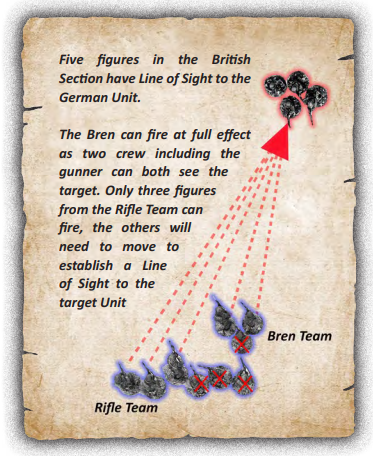
engage with. Line of Sight is determined by tracing a
straight line from each figure to the target. Figures in
Open Ground have 360° visibility and are able to see all
other units if no terrain breaks their Line of Sight.
Where individual figures are located on the table is
important. Line of Sight, and consequently the ability
to shoot at a target, is broken by any intervening figures
between a figure wishing to fire and the target enemy
Unit.
Terrain Affecting Visibility
The following terrain can affect visibility:
Linear Obstacles
Intervening Terrain
Area Terrain
Buildings
Elevated Terrain
2.4.1 Linear Obstacles & Intervening Terrain
Linear Obstacles vary in height and size and their effect
on visibility reflects this.
Intervening Terrain is a feature located between two
Units but to which neither are adjacent.
Where a Unit is in contact with an obstacle, such as a
hedge or fence classed as a Minor or Medium Obstacle,
this will not affect its Line of Sight.
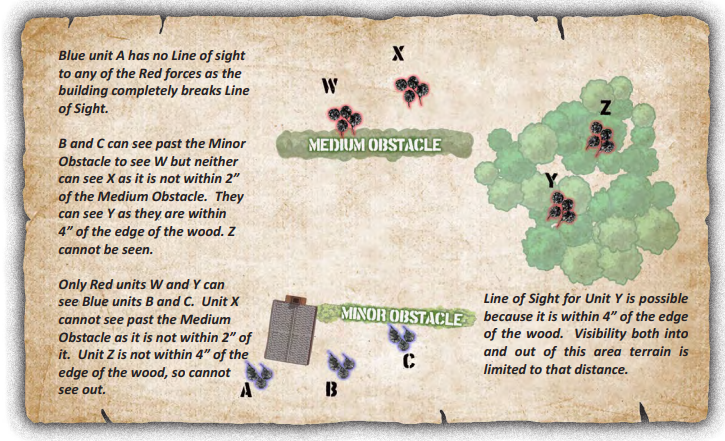
Line of Sight is broken if it crosses four intervening Minor
Obstacles, such as garden hedges, small fences or similar.
Where Line of Sight crosses a Medium Obstacle, such as
a high hedge or fence, it extends 2" beyond that obstacle
but no further.
Where Line of Sight crosses a Major Obstacle, such as a
high wall, it is broken unless a Unit is directly adjacent to
the obstacle, lining it, and able to fire from that position.
2.4.2 Area Terrain
Area Terrain is an area of ground within which Units can
be located, such as woods, orchards or standing crops.
Line of Sight into, or through, an area of terrain where
visibility is lightly obstructed, such as orchards, is broken
when it travels 6" into the terrain from the edge. Troops
inside this type of area terrain can see up to 18" within it.
Line of Sight into an area of terrain where visibility is
badly obstructed, such as woods, is broken when it
travels 4" into the terrain from the edge. Troops inside
this type of area terrain can see up to 12" within it.
If a piece of Area Terrain that intervenes between two
Units, whether Line of Sight is broken is determined by
the density of the terrain, as outlined above. Only where
the area of terrain is wide enough to break Line of Sight
does visibility end.
2.4.3 Buildings
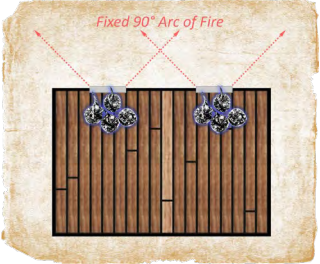
A unit in a building will only be visible if it is within 4" of
a window, door or similar aperture. An aperture
reduces visibility to a 90° arc directly out from the
window or door, 45° from the perpendicular,
measured from the face of the aperture. A unit
looking into a building may only do so if it is located
within the same 90° arc.
Troops in Buildings
Units in buildings have a special status as, whilst we
can see the figures on the table, our miniature troops
may not actually be aware that they are there. A unit
in a building can only be targeted with Fire for Effect
by enemy units who are aware they are there and also
have Line of Sight to them. To be aware of an enemy in a
building, one of the following must apply:
The target Unit has revealed itself by firing from the
building.
The target Unit was seen entering the building by the
unit that wishes to fire at it.
Infantry or Support units within 18" of a building
are automatically aware of an enemy inside. They
do not need to see the Unit to be aware of them.
However, unless firing H.E., the firer must have Line
of Sight to the target unit to be able to fire.
Note: Suppression Fire may always be used against a
building, even when the firer is unaware of a Unit inside
it and has no Line of Sight to that Unit.
2.4.4 Elevated Terrain
Where the firer is elevated, such as in the upper stories of
a house or the turret of a tank, Line of Sight is measured
from the elevated position and ignores any intervening
terrain which does not break Line of Sight.
2.4.5 Visibility & Vehicles
All vehicles may be seen by any unit in Line of Sight.
Passengers and crew in a Transport vehicle can be seen
if the vehicle can be seen. Passengers and crew in an
Armoured Personnel Carrier (APCs) can only be seen if
they are manning exposed weapons positions, such as
an LMG on a halftrack. Crews inside Armoured Fighting
Vehicles (AFVs) can never be seen.
Hull weapons on AFVs measure their Line of Sight from
ground level and cannot see, or fire, through intervening
friendly units.
Turret weapons measure from the higher weapon
position and can fire over friendly troops if they have an
unobstructed Line of Sight to the target Unit.
Low Profile AFVs always measure Line of Sight from
ground level.
2.4.6 Smoke
All infantry Sections and some Support Units and vehicles
are able to deploy smoke which affects visibility. Some
smoke breaks Line of Sight entirely, meaning that nothing
can fire through. Some smoke reduces visibility so that
Line of Sight still exists but any firing into or through it is
done with a penalty.
Smoke occurring as a result of he following entirely
blocks Line of Sight:
Bombardment
Smoke Barrage
A Burning building
British 2" mortar
Vehicle with smoke dischargers
Smoke resulting from the throwing of smoke grenades
and collapsed buildings reduces visibility but does not
block Line of Sight.